Analytical solutions for two-phase
Laplace’s law
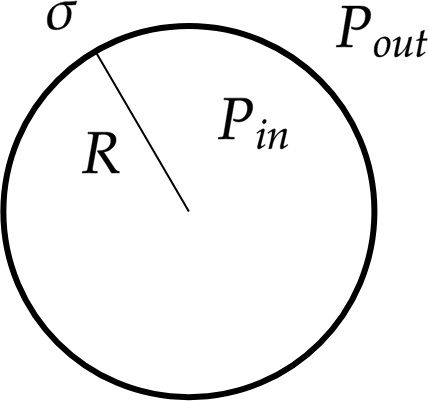
The difference between the pressure inside the droplet \(P_{in}\) and the pressure outside \(P_{out}\) is equal to
(702) \[\underbrace{P_{in}-P_{out}}_{\Delta P}=\frac{\sigma}{R}\]
where \(\sigma\) is the surface tension and \(R\) is the droplet radius.
Analytical solution of double-Poiseuille flow
(703) \[\begin{split}u_{x}(y)=\begin{cases}
\frac{Gh^{2}}{2\eta_{A}}\left[-\left(\frac{y}{h}\right)^{2}-\frac{y}{h}\left(\frac{\eta_{A}-\eta_{B}}{\eta_{A}+\eta_{B}}\right)+\frac{2\eta_{A}}{\eta_{A}+\eta_{B}}\right] & \mbox{if }0\leq y\leq h\\
\frac{Gh^{2}}{2\eta_{B}}\left[-\left(\frac{y}{h}\right)^{2}-\frac{y}{h}\left(\frac{\eta_{A}-\eta_{B}}{\eta_{A}+\eta_{B}}\right)+\frac{2\eta_{B}}{\eta_{A}+\eta_{B}}\right] & \mbox{if }-h\leq y\leq0
\end{cases}\end{split}\]
(704) \[G=\frac{u_{c}}{h^{2}}(\eta_{A}+\eta_{B})\,\,\mbox{and}\,\,u_{c}=5\times10^{-5}\]
Analytical solution of Prosperetti for capillary wave
The example of such a study is given by the test case of capillary wave. For that test case, an analytical solution exists . The objective is to study the influence of mesh on the solution accuracy. The amplitude is
(705) \[a(t)=\frac{4(1-4\beta)\nu^{2}k^{4}}{8(1-4\beta)\nu^{2}k^{4}+\omega_{0}^{2}}a_{0}\text{erfc}(\nu k^{2}t)^{1/2}+\sum_{i=1}^{4}\frac{z_{i}}{Z_{i}}\left(\frac{\omega_{0}^{2}a_{0}}{z_{i}^{2}-\nu k^{2}}-u_{0}\right)\times\exp[(z_{i}^{2}-\nu k^{2})t]\text{erfc}(z_{i}t^{1/2})\]
where \(\nu\) is the kinematic viscosity which is identical for both fluids, \(k\) is the wave number which is related to the wavelength \(\lambda\) by \(k=2\pi/\lambda\) . The coefficient \(\beta\) is defined by the liquid \(\rho_l\) and gas \(\rho_g\) densities:
(706) \[\beta=\frac{\rho_{l}\rho_{g}}{(\rho_{l}+\rho_{g})^{2}}\]
\(\omega_0\) is the inviscid natural frequency given by
(707) \[\omega_{0}=\frac{\rho_{l}-\rho_{g}}{\rho_{l}+\rho_{g}}gk+\frac{\sigma k^{3}}{\rho_{l}+\rho_{g}}\]
where \(g\) is the gravity. In the following verifications \(g=0\) . The \(z_i\) ’s are the four roots of the algebric equation
(708) \[z^{4}-4\beta(k^{2}\nu)^{1/2}z^{3}+2(1-6\beta)k^{2}\nu z^{2}+4(1-3\beta)(k^{2}\nu)^{3/2}z+(1-4\beta)\nu^{2}k^{4}+\omega_{0}^{2}=0\]
and
(709) \[Z_{1}=(z_{2}-z_{1})(z_{3}-z_{1})(z_{4}-z_{1})\]
Coalescence of two equal cylinders
The analytical solution is written in . The contour is given by:
(710) \[x(\theta)=R_{0}\left[(1-m^{2})(1+m^{2})^{-1/2}(1-2m\cos2\theta+m^{2})^{-1}\right](1+m)\cos\theta\]
(711) \[y(\theta)=R_{0}\left[(1-m^{2})(1+m^{2})^{-1/2}(1+2m\cos2\theta+m^{2})^{-1}\right](1-m)\sin\theta\]
where \(R_0\) is the radius of both droplets. In Eqs (710) and (711) the parameter \(m\) can be related to physical properties of surface tension \(\sigma\) , dynamic viscosity \(\eta\) and time \(t\) by
(712) \[\frac{\sigma t}{\eta R_{0}}=\frac{\pi}{4}\int_{m^{2}}^{1}\left[\mu(1+\mu)^{1/2}K(\mu)\right]^{-1}d\mu\]
where the function \(K(\mu)\) is defined by
(713) \[\begin{split}K(\mu)&=\int_{0}^{1}\left[(1-x^{2})(1-\mu x^{2})\right]^{-1/2}\\
&=\int_{0}^{\pi/2}(1-\mu\sin^{2}\theta)^{-1/2}d\theta\end{split}\]
References
Section author: Alain Cartalade