Contact angle
Law of Young-Dupré
Law of Young-Dupré
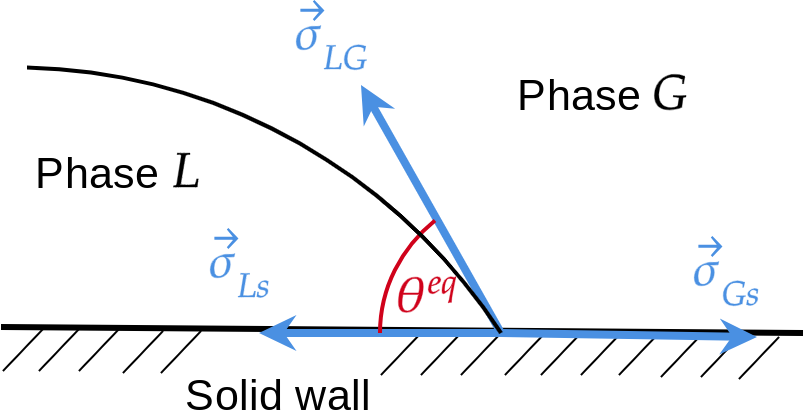
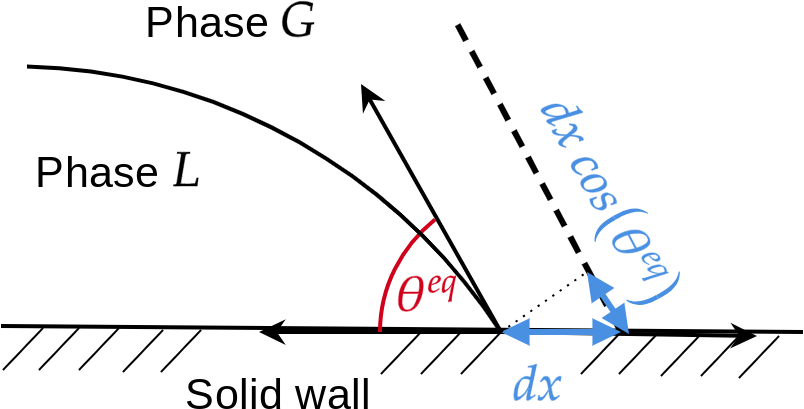
When a liquid (phase \(L\)) and a gas (phase \(G\)) are in contact with a solid wall, there is an equilibrium angle \(\theta^{eq}\) corresponding to the equilibrium of three capillary forces \(\vec{\sigma}_{Ls}\) the capillary force between Liquid and solid, \(\vec{\sigma}_{Gs}\) the capillary force between Gas and solid, and \(\vec{\sigma}_{LG}\) the capillary force between Liquid and Gas (see Fig. Contact-Angle-Concept). The contact angle \(\theta^{eq}\) can be expressed with the three surface tensions by the Young-Dupré law. Its derivation (see [1]) can be performed with the work \(d\mathcal{W}\) of a small displacement \(dx\) (see Fig. Young-Dupre-Derivation):
At equilibrium \(d\mathcal{W}=0\) and we obtain:
Boundary condition for diffuse interface
Wall free energy
In the case of phase-field theory, the minimization is now carried out with an additional free energy: the wall free energy \(\mathscr{F}+\mathscr{F}_{w}\) where
where \(d(\partial V)\) is the wall surface, and \(p(\phi)\) is the interpolation polynomial \(p(\phi)=\phi^{2}(3-2\phi)\). The variation \(\delta(\mathscr{F}+\mathscr{F}_{w})/\delta\phi\) yields:
where \(\hat{\boldsymbol{n}}\) is the normal vector at the wall boundary. After using the Young-Dupré law, we obtain the boundary condition for the phase-field \(\phi\) at the solid surface:
Remark: if \(\theta^{eq}=90{^\circ}\) then \(\boldsymbol{\nabla}\phi\cdot\hat{\boldsymbol{n}}=0\)
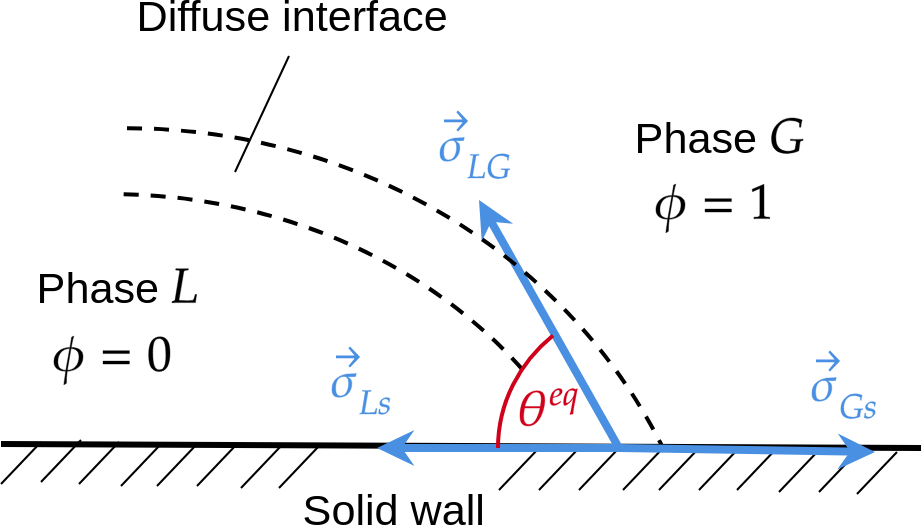
Contact angle for diffuse interface
References
Section author: Alain Cartalade